
Understanding Dolphin Behavior: Insights into the Lives of Key West Dolphins

Introduction
Dolphins are among the most intelligent and socially complex marine mammals, captivating humans with their playful antics and intricate behaviors. These fascinating creatures play a vital role in marine ecosystems, serving as both predators and indicators of ocean health. This blog post focuses on the coastal Atlantic bottlenose dolphins found in Key West—one of the most commonly seen dolphin species in Florida—offering insights into their unique behaviors and social structures.
Discover how our Key West eco tours provide a closer look at dolphin behavior and their vital contributions to the ocean environment.
Dolphin Personalities and Traits
Dolphins exhibit a range of personalities, much like humans and it can be easy to relate to them. Somewhat embarrassingly, when we had our first baby, it really stood out how much humans and dolphins can relate to each other as intelligent and social animals. Some dolphins are curious and bold, while others are more reserved and cautious. And the mothers are nurturing and clearly loving but you can see when they’ll get frustrated with their baby for not taking a nap. Researchers have observed dolphins with playful, inquisitive natures often engaging with boats and swimmers, contrasting with those who prefer solitary exploration.
Physical traits include a long, streamlined body insulated with blubber, aiding in thermoregulation and buoyancy. Bottlenose dolphins are known for their intelligence, demonstrated by their complex social structures and problem-solving abilities. Their social groups, known as pods, are dynamic and can change as dolphins merge or split from different groups based on their needs and activities.
Daily Dolphin Activities
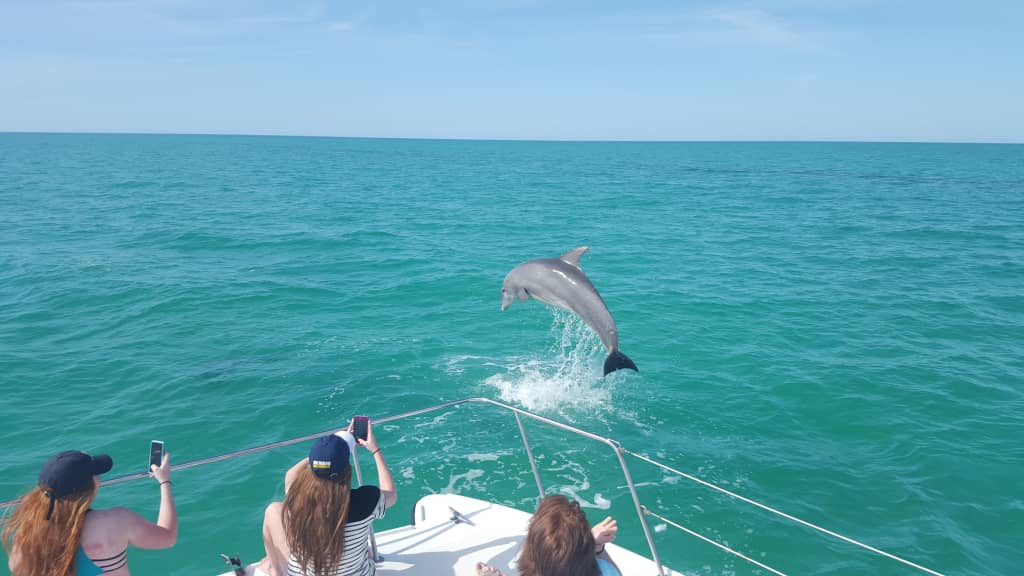
Daily life for Key West dolphins is a blend of foraging, socializing, and playing. Foraging often involves sophisticated hunting techniques like cooperative hunting, where dolphins work together to herd fish into tight groups for easier capture. Socializing is crucial for maintaining social bonds and involves a range of activities from synchronized swimming to gentle physical contact like pectoral fin rubbing. Play is also an essential part of their day, with dolphins engaging in activities such as leaping out of the water, chasing each other, and interacting with floating objects like seaweed. Around Key West, many of these daily routines play out at the dolphins’ playground, a calm, shallow sandbank the resident pods return to day after day.
Bottlenose Dolphin Specifics
Bottlenose dolphins, specifically the Tursiops truncatus species, are highly adaptable and exhibit a variety of behaviors that distinguish them from other dolphin species. They are known for their echolocation abilities, which allow them to navigate and hunt in murky waters where visibility is low. Unlike porpoises, which have a shorter, stouter build and spade-shaped teeth, bottlenose dolphins are more streamlined with a distinct beak and conical teeth. Their dorsal fins are more curved compared to the triangular fins of porpoises, aiding in their agility and speed.
Learned Behaviors and Cultural Transmission
Dolphins are known for their remarkable ability to learn and pass on behaviors, a phenomenon known as cultural transmission. One well-documented example is seen in Shark Bay, Australia, where dolphins use marine sponges to protect their rostrums while foraging on the seafloor. This tool use is taught from mother to offspring, showcasing how knowledge is transferred across generations. Another fascinating behavior observed in the Florida Keys is silt netting, where dolphins create curtains of silt by swimming quickly in circles to trap and catch fish. This unique technique is predominantly performed by female dolphins, who then pass these skills onto their offspring.
Dolphins also exhibit mimicry, which plays a crucial role in social learning and maintaining cohesion within pods. By mimicking the actions of their peers, dolphins can quickly learn new skills and behaviors essential for survival. These learned behaviors highlight the advanced cognitive abilities of dolphins and their capacity for cultural evolution. The ability to adapt and pass on complex behaviors not only underscores their intelligence but also enhances their adaptability in changing environments.
Behavioral Adaptations for Survival
Dolphins have developed numerous adaptations to thrive in their environments, with echolocation being one of the most remarkable. Echolocation involves emitting a series of clicks and listening to the returning echoes to determine the location, size, and shape of objects around them. This capability is so refined that dolphins can detect a fish the size of a golf ball from over 100 yards away, even in murky waters where visibility is near zero.
By analyzing the time it takes for the echoes to return, dolphins can form a mental image of their surroundings, allowing them to hunt effectively even in the dark. In addition to locating prey, echolocation helps dolphins navigate through complex underwater environments, avoiding obstacles and communicating with other dolphins.
But what makes their echolocation truly astounding is the comparison to other creatures. While dogs are renowned for their keen sense of hearing, able to detect sounds up to 65 kHz, dolphins can hear up to an astonishing 150 kHz. That’s more than twice the range of our canine companions. Elephants, which communicate with infrasound, have an impressive hearing range but are still outmatched by the dolphins’ precision in detecting high-frequency sounds underwater. Humans, on the other hand, hear up to 20 kHz at best, making our auditory capabilities pale in comparison. This super-hearing allows dolphins to detect and track prey with incredible accuracy, even differentiating between objects as small as a golf ball and a ping-pong ball based on density.
Cooperative hunting strategies are another sophisticated adaptation seen in dolphin behavior. Dolphins often work together in groups to herd fish into tight balls, making them easier to catch. An example of this is the technique known as “silt netting,” unique to the Florida Keys, where dolphins create a curtain of silt by swimming rapidly in circles to trap fish. These coordinated efforts highlight their ability to plan and execute complex strategies as a team.
Social structures, such as forming alliances and pods, further enhance their survival rates by providing mutual protection against predators. For instance, when threatened by sharks, dolphins will band together, using their speed and agility to fend off the predator and protect their group members. These social and behavioral adaptations underscore the intelligence and resilience of dolphins in their natural habitats.
Social and Mating Behaviors
The social structure of bottlenose dolphins is intricate, involving long-term bonds and complex alliances. One of the most fascinating aspects of their behavior is their mating strategies, which include elaborate courtship displays and the formation of male alliances to increase their chances of mating success.
Male bottlenose dolphins often form what is known as first-order alliances, which consist of two to three males that cooperate to court females and fend off rival males. These alliances can be stable and last for many years, sometimes even over a decade. The cooperation between these males allows them to control and guard estrous females, increasing their chances of successful mating. In some cases, these alliances can further form second-order alliances, where two or more first-order alliances join forces to take females from other groups. This level of cooperation among male dolphins is rare in the animal kingdom and highlights their advanced social intelligence.
Courtship behaviors in bottlenose dolphins are equally sophisticated. Males often engage in displays of physical prowess, such as leaping out of the water, creating bubble streams, and using a range of vocalizations to attract females. These behaviors are not just random acts but carefully coordinated efforts to demonstrate their fitness and desirability as mates. Female dolphins are typically more selective, often choosing mates based on these displays and the males’ ability to protect them from other suitors.
Females give birth to a single calf after a gestation period of about 12 months. Births usually peak in the warmer months of spring and summer. Calves are born tail-first and must quickly be brought to the surface to take their first breath. Mothers are highly attentive and provide extensive care, nursing their calves for up to 18-20 months and teaching them essential survival skills. The bond between mother and calf is strong, with calves staying close to their mothers for several years to learn foraging techniques, social behaviors, and navigation skills.
This period of maternal care and social learning is critical for the calves’ development. As they grow, young dolphins gradually become more independent, joining juvenile groups where they continue to learn and refine their skills until they reach sexual maturity. The combination of intricate social structures, cooperative behaviors, and elaborate mating strategies underscores the complexity and sophistication of bottlenose dolphin societies.
Aggression and Perceived Negative Behaviors
Aggression among dolphins can occur in various contexts, such as competition for mates or dominance disputes. Instances of aggressive behavior include ramming, biting, and chasing, often seen in male dolphins vying for mating rights or establishing social hierarchy. While these behaviors might be perceived as “bad,” they are natural aspects of dolphin social interactions and play crucial roles in their social structure. Understanding these behaviors within their natural context helps dispel myths and promotes a more nuanced view of dolphin society.
Conclusion
Understanding dolphin behavior is not only fascinating but also essential for their conservation. By studying their personalities, daily activities, and social structures, we gain insights into their complex lives and the challenges they face. This knowledge helps inform conservation efforts, ensuring that these incredible animals continue to thrive in their natural habitats. Protecting dolphins and their environment is crucial for maintaining the health and balance of marine ecosystems.
Understanding the intricate behaviors and social dynamics of dolphins deepens our appreciation for these remarkable creatures. To witness these behaviors firsthand, join Honest Eco’s dolphin watch tour in Key West. Our tours are designed by biologists to provide an educational and immersive experience, offering you a unique opportunity to observe dolphins in their natural habitat. Discover their playful interactions and complex social structures up close. Visit Honest Eco Tours to learn more and book your unforgettable dolphin adventure today!
References
- Sarasota Dolphin Research Program. (n.d.). Retrieved from Sarasota Dolphin Research Program
- MarineBio Conservation Society. (n.d.). Retrieved from MarineBio Conservation Society
- Ridgway, S. H. (2000). The Auditory Cortex of Dolphins.
- Herzing, D. L. (2001). Cracking the Code: Communicating with Dolphins.
- Marino, L. (n.d.). Dolphins Keep Lifelong Social Memories.
- Norris, K. S. (1960). Echolocation in Dolphins.
- Dolphins and Sounds.
- Islamorada Times. (n.d.). Sharks in the Florida Keys. Retrieved from Islamorada Times
- NOAA Fisheries. (n.d.). Bottlenose Dolphin. Retrieved from NOAA Fisheries
- Marine Mammal Center. (n.d.). Dolphin Communication. Retrieved from Marine Mammal Center
We Think You'd Like This Eco Friendly Tour

Recent Posts

Sargassum in Key West: What Actually Happens Each Summer, and What It Means for Your Trip
Sargassum in Key West, explained by a biologist captain: when seaweed season runs, which beaches get it, what lives in it, and how we find clear water.

The Dolphin Playground: Key West’s Wild Dolphin Gathering Spot
The Dolphin Playground is where Key West’s wild dolphins rest, hunt, and play. A biologist explains why they gather there — and how to visit responsibly.

Key West in July: Weather, Events, and the Best Things to Do
Visiting Key West in July? An honest local guide to the weather, the 4th of July, festivals, and the best things to do on and off the water.

Things to Do on the Way to Key West: The Best Stops Along the Overseas Highway
Driving to Key West? Here are the best stops along the Overseas Highway — from John Pennekamp to Bahia Honda — by a Key West eco-tour crew.
Snorkeling in Key West From Shore: A Local Guide to the Best Snorkeling Beach Spots
A local guide to the best beach snorkeling in Key West and the Florida Keys — where to go, when to go, and what you’ll actually see underwater.

Best Time and Places to See Dolphins in Key West
Wondering where to see dolphins in Key West and the best time to spot them? Local, family-friendly tips on seasons, timing, and best places.
View Our Honest Eco Tours
Dolphin Watch + Guided Snorkel
The Original Dolphin Watch and Snorkel, since 1986! Offered year-round.
Dolphin Watch + Guided Snorkel
The original Key West Dolphin Watch and Snorkel, since 1986! Offered year-round.

Kayak tour + Guided Snorkel & Morning Sail
Kayak tour of the mangroves, plus a Guided Snorkel
Kayak tour + Guided Snorkel & Morning Sail
Kayak tour of the mangroves, plus a Guided Snorkel

Dolphin Watch + Sunset Catamaran Sail
Our most mellow tour. Search for dolphins under a setting sun. This tour does not feature snorkeling. Offered Nov - Apr.

Sandbar Charter + Private Snorkeling
Perfect for small friend groups and families. Book a Private charter aboard our 6 passenger maximum boat Cowfish.

Private Charters: Choose your own Adventure!
Prices vary by tour, boat and group size. Book online or customize.

All The Above
Private group Tour: Kayak tour of the mangroves, guided snorkel, sail, enjoy an organic lunch and search for dolphins

Sunset Catamaran Sail + Reef Snorkel & Sandbar
This Reef Snorkel and Sandbar visit takes advantage of the warm calm weather.